Sep. 24, 2026
Stellar Photonix is pleased to announce that its self-developed 3m optical remote sensing payload has captured its first images in orbit. The payload was launched aboard the Lijian-1 Yao-18 launch vehicle on September 20.
Following successful in-orbit commissioning, including power-on self-tests, parameter calibration, and imaging system activation, the payload began its initial imaging operations in orbit.
Initial imaging was successfully demonstrated across three operating modes: snapshot imaging, push-broom imaging, and video imaging, providing an important in-orbit demonstration of the payload’s optical imaging and on-board AI capabilities.
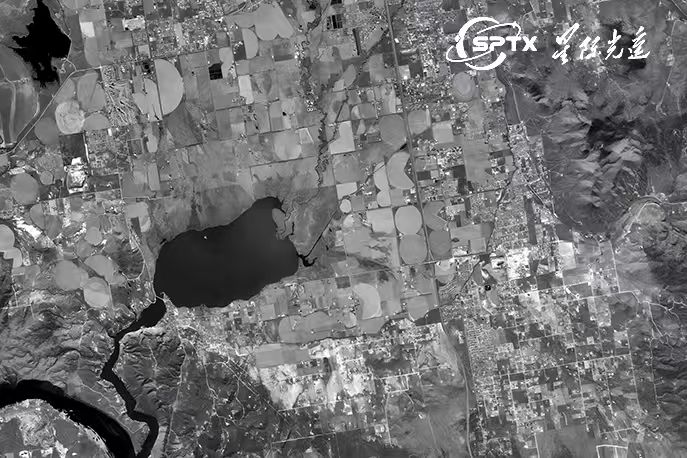
The snapshot image captures a diverse scene featuring water bodies, irrigated agricultural fields, and urban built-up areas.
AI-Enabled Intelligent Perception
The payload incorporates on-board AI-based intelligent perception, enabling automatic target detection and classification in complex scenes. Combined with its lightweight and high-precision design, the system supports intelligent processing directly on the satellite for applications including natural resource surveys, water resource monitoring, agricultural observation, and urban development monitoring.
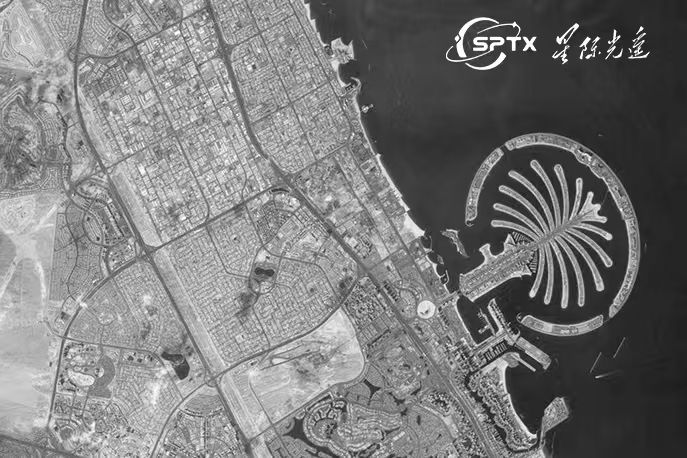
The push-broom image captures a wide-area view of Dubai, including Palm Jumeirah, The World Islands, and surrounding urban areas.
AI-Based Adaptive Attitude Control
The payload features AI-based adaptive attitude control, enabling continuous push-broom imaging while maintaining image stability and geometric consistency across wide-area scenes.
This capability supports large-area Earth observation applications, including coastal monitoring and urban mapping.
The payload also demonstrated stable continuous operation in video imaging mode, producing clear imagery with consistent exposure and well-defined surface features.
Real-Time On-Board AI Processing
The payload integrates real-time on-board AI processing, enabling dynamic target detection, image enhancement, and preliminary analysis directly in orbit.
By moving part of the processing workflow from the ground to the satellite, the system can reduce reliance on extensive ground-based post-processing and improve the efficiency of remote sensing operations for applications such as emergency response, port and waterway monitoring, and dynamic target observation.
Initial in-orbit results demonstrate stable imaging performance, with key performance indicators—including spatial resolution, swath width, signal-to-noise ratio (SNR), modulation transfer function (MTF), geolocation accuracy, and data transmission rate—meeting the expected design targets.
The results demonstrate the payload’s ability to perform reliably in the space environment while supporting the requirements of on-board AI-enabled Earth observation applications.
The successful acquisition of the first in-orbit imagery marks an important milestone for Stellar Photonix’s self-developed 3m optical payload, demonstrating its optical performance, imaging capability, and on-board AI processing capabilities in orbit.
Stellar Photonix will continue its in-orbit testing and parameter optimization program, with a focus on further refining imaging performance and operational stability.
Building on this milestone, Stellar Photonix will continue to advance its optical remote sensing payload technologies for applications including natural resource surveys, ecological monitoring, urban observation, disaster prevention, and emergency response, supporting the growing demand for reliable Earth observation solutions.
Latest Blogs

Apr. 02, 2026
An Introduction to Space Situational Awareness
In 2020, the number of satellites launched globally exceeded 1,000 for the first time, reaching approximately 1,200-1,300 . Just six years later, the planned launch count for 2026 is a staggering 3,000-4,000 . Technologies such as rocket recovery, multiple satellite launches per rocket, and mass production have reduced the cost of launching into space to a quarter of what it was a decade ago.
Quick Links
Quick Links

